Thanks for visiting our Blog. Find out more at www.fit2tri.com.au or contact us at enquiries@fit2tri.com.au

Wednesday, 12 June 2013

Goal Setting - A Waste of Time ?


In the mid 90's a study was published in a magazine around what makes successful people successful.

It looked at high flying business executives, champion sportspeople, media personalities to try and find what common traits they possessed. One of the common traits was about the setting of goals.

They Didn't.

This is a trend that continues with modern organisations such as Google who do also not set annual goals.

When asked in the same study why these people and organisations do not set goals the response was simple.

"Defining goals defines your limitations"

As an example picture a 4 hour marathon runner who's goal it is to run a sub 3:30 marathon.  They work out what they need to do - train to that specific pace and come race day run a 3:29.  Goal Met.

Now imagine a 4 hour marathon runner who commits each week to followed a balance program of muscular endurance, weights, track work. Each week they meet this commitment - a commitment to continuously improve.  Come race day they run 3:19.

Imagine if, for Runner 1, a 3:30 marathon was never realistic based on time till the event, training time etc ?  Had they focussed on improvement over the goal they may have run 3:39 which is still a huge PB.  Instead they 'miss' their goal and are disappointed or worse still are injured trying to push for an unrealistic goal and cant run the marathon at all.

The same is common for people trying to lose weight.  They set a goal instead of focussing each day on eating smart and exercising properly.  For weight loss the issue also can be that a long terms goal is hard to be motivated for and 'slip ups' in nutrition are ok as they have 'months' left..

In Googles case they dont set corporate goals as it decreases their agility - the ability to respond to what the market is doing (which is often outside their control anyway).

There have been lots of studies on what makes successful people successful such as Stephen Coveys Seven Habits of Highly Successful People.  Things like single mindedness, focus, total commitment to a goal etc.  Not surprisingly you dont see many books on what makes abject failures unsuccessful but in some studies that have been conducted it has been found that these people actually execute the same habits.  Single Mindedness, total commitment to a goal etc can make the person oblivious to 'reality', unable to deal with changes to their market or environment.

So rather than defining your own limitation focus on continual improvement and commit to each day doing something that makes you 1% better than yesterday.  In 68 days you will be 100% better than you were yesterday.

Wednesday, 5 June 2013

Ketosis for Dummies


What is Ketosis

Ketosis is a state of elevated levels of ketone bodies within the body.  Ketones are a preferential fuel source for the brain and muscles.


What is the advantage
Within our liver and muscles we can store a maximum of about 1800 calories of glycogen.  For HARD exercise this means we have about 1 hour 50mins worth of energy.  Conversely an average athlete has about 65,000 calories of stored fat.

Ketones also burn 'clean' meaning less destructive bi-products compared to sugar which our bodies would need to process or clear.

By using body fat ketosis is a great way to 'lean up' whilst still maintaining energy levels as well as reducing blood glucose and insulin.

How do we measure it.
There are two methods of measuring ketones - urine or blood.  The difference is in the type of ketones measure.  Urine analysis measures levels of Acetoacetate.  Logically what appears in urine is what the body is trying to get rid of rather than what is used.  Blood analysis measures beta-hydroxybutyrate which are used by the muscles and brain for energy so is a better indicator of what is available and being utilised.

Blood analysis is performed using a simple meter (most of which can also measure blood glucose) available from chemists for under $50.

What is Nutritional Ketosis
Nutritional Ketosis is the 'sweet spot' for ketosis where blood ketones are in the range of 0.2 2.0 mmol/l

Can it be harmful
Yes.  Above 5mmol/l starts to move into what's called Ketoacidosis effecting the acidity of blood.  It is also strongly not recommended for type I diabetics.

How do I do it.
In simple terms a high fat / low carb diet is used to enable ketosis however the risk of too much fat as a ratio can push the body into ketoacidosis.  Similarly too much protein can lower the ketone level through a mechanism called gluconeogenesis.  It is commonly found that a diet ratio of 80% fat, 15% protein and 5% carbohydrate is optimal for nutritional ketosis.

Intermittent fasting has also been shown to increase blood ketones.

Isnt that Atkins ?
No.  Atkins is high protein, high fat which as mentioned reduces blood ketones through conversion of protein to glucose.


Wednesday, 22 May 2013

Length Matters


Back in High School (a long, long, long time ago) I managed to win 3 awards in the Australian Mathematics Competition.  Maths I could do (Geography not so much).

So I often look at sporting challenges from a mathematical or physic perspective.

Consider these Maths.

The average good runner has a cadence of around 94rpm or 188 Steps per Minute (spm).  If it takes them 3hours and 10minutes to run a marathon then they take 190 x 188 steps or 35720 steps.

As a side point here can you see why a lighter shoe is better ?  A shoe that is 100g lighter means lifting 357 LESS kilograms in a marathon.

Back to the maths.

To take 35720 steps over 42.2 means each step takes 118 cm.  Press M+ to remember that number.

If, like most people, you want to run a sub 3 hour marathon (2:59:00) then we are taking 179 x 188 steps which is 33652 steps.  These 2000 odd less steps means our stride length is 125cm - a difference of 7 cm or 5%. Grab a ruler and look at 7cm - it aint that much.  In fact it's 3/4 of the length of the average soft drink can.

So to go from a 3:10:00 marathon to a 2:59:00 is a 5% increase in stride length.

If you wanted to go from a 3:10:00 marathon to a 2:59 marathon WITHOUT changing stride length it  would mean still taking 35720 steps but this time in 179 minutes which means your cadence would need to go up to 200 steps per minute.  This is a 6.3% increase in cadence (and a much higher energy consumption) and from my experience holding a cadence greater than 97 for a marathon duration is almost impossible.  Most World Record holders have broken the record using a cadence of 90-94.  If we look at the maths for that it means 182 steps x 123 minutes or 15129 steps which means a stride length of 278cm (wow)

When cadence starts to max out the only way to get faster is to increase stride length.  As you can see from the maths - even a relatively small (5%) increase can be the difference between languishing just above 3 hours and breaking that magical barrier.

Stride length can be increased in a number of ways.  Drills, stretching (PNF or Ballistic), Bounds/Strides etc  Of course care must be taken to avoid overstriding.

As in cycling and swimming cadence or turn over is extremely important but when you reach the max in cadence and seem to be languishing - look at stride length.

Wednesday, 15 May 2013

What's your (swim) number.

"You need to breath bilaterally - you need to breath every third stroke"


I hear this all the time from 'coaches' and 'arm chair experts'.

Being able to breath bilaterally (on both sides) is definitely a skill that needs to be developed.  Breathing bilaterally has benefits such as


Balance
People who only breath on one side tend to have an asymetrical body roll and position - typically rolling more on the breathing side.  This means than on the non breathing side they typically have less lat muscle and more deltoid engagement (using a smaller muscle).  They often mention feeling less strong on that side.  Balance (or lack of) makes it harder to swim in a straight line especially with no black line for reference.

Responding to conditions
Imagine you are swimming straight along a beach and you have trained only breathing on the 'ocean' side.  Any type of swell and you end up sucking a lot of water.  Being able to change sides means you breath where the conditions are easiest.

Sighting
Similar to above if you are swimming down a beach and always looking out to sea how will you know when you are near the turn buoy without constantly looking up (hint - look for land marks on any open water swims rather than relying on sighting the buoy.

Protection
If you swimming close to someone on your breathing side breathing on the other side turns your face away from them reducing the risk of being hit.

So if bilateral breathing has all these advantages then I should breath every third stroke ?

No.

Bilateral literally means both sides.  There is nothing that specifies every 3rd stroke (commonly called "breathing on the three").  Every person is different - everyone has different lung capacities, different hematocrits, different VO2, different stroke efficiencies, different turn over rates (cadence).  The need for air can also change during an event as your pace changes.

Bilateral means you CAN breath both sides.

Some people breath every second stroke.  For most of a race I will actually breath every four strokes.  I find that if I try and breath every second stroke it is borderline hyperventilating but everyone is different.  The key is though that even though breathing on an even number means you are always breathing on the same side that side will change based on conditions.  During a race I may switch sides (but still breath on the same count) based on conditions, seeing where people are, protection etc

If you have a look at this video of Kieran Perkins winning Gold at the 1996 Olympics you will note that he is breathing every 2nd stroke BUT he changes sides so he can see where his competition is in the pool.


Being able to breath on both sides is definitely a skill you should develop but do this based on a breathing rhythm you are comfortable with.  For example if you set is 10 x 100 do them alternating sides each interval - or even go up the pool breathing left, down the pool breathing right.  Develop the skill without forcing yourself to breath every third stroke.  Practise breathing both sides using drills - you will find that if you cant breath on one side it means there is an issue with your stroke on that side.  Have someone check out your stroke and see what's causing the issue

Friday, 10 May 2013

10 Tips to Training with an Injury

Four weeks ago it was a nice morning so I decided to go for a run.  It wasnt a tempo run or an interval run - just a nice run to enjoy the sunshine and the beach.  About 2km into the run BANG - a searing pain my  right foot.  By the end of the day I couldnt even put weight on the foot.

Surely my life was over, my fitness would evaporate and I would be morbidly obese by the end of the week (this seems to be the thinking whenever an athlete gets an injury..)

The next day I went to get it checked out - I went to see Astrid at Brighton Podiatry.  I like Astrid - if you want warm and fuzzy buy a kitten - if you want to know the facts go see Astrid.  A ultrasound scan revealed a 17mm tear and inflammation  in a tendon in my foot.

Tip 1.  Find out quickly from a professional what the problem is.  Dont go see a GP, dont see a physio, dont spend hours checking out Doctor Google - find out the real issue fast.

According to Astrid I couldnt run for 6 weeks.  Weight bearing was out - even swimming was to be avoided (due to plantar flexing)  Astrid's partner is a runner - she understands the mindset.  Rather than focussing on what I cant do I asked Astrid what I could do.  There is an important difference between pain and damage.  For example riding a bicycle in a carbon soled shoe was painful but, according to Astrid, wasnt going to cause further damage.  Riding up hills (additional stress on foot) was out but flat riding was fine.

Tip 2.  Find a professional you can work with.  Find out what you can do rather than just what is off limits.


For most of the day I wear an airboot.  One of the keys to healing is to make sure you dont create a situation that will cause you to re-injure ie healing in a shortened state.  This is an important one for things like Achilles etc.  Simply having a cortisone injection would mask the problem (pain) but would not allow for proper healing.  The boot keeps the foot flexed which means the tendon doesn't heal in a shortened state.  I also roll the foot on a hockey ball to facilitate blood flow.

Note I avoid Anti-inflammatories due to the direct link to gut issues (Cox-2 Inhibitors)

Tip 3.  Heal the injury - dont just mask the pain.  Would you just take pain killers for a broken arm or have it re-set in place ?

So far the first 3 tips have been fairly obvious - now we get lateral.

Nutrition
Most injuries cause inflammation.  If we are introducing other inflammation into our body we slow the healing processes.  My diet is pretty good but after the injury I decided to not work against my body and focussed on cutting out inflammatory foods even more.  Wheat (even hidden wheat in gravies, hamburgers, crumbs etc), refined sugars - I focussed on cutting these out completely.

Tip 4.  Dont work against your body.  Dont 'distract' the healing by creating other problems.  Be stricter on an anti-inflammatory diet.

There are several supplements that can aid with healing.  Colostrum and Lacto Ferrin are two I use to help the body heal faster.

Tip 5  Look at supplements that can help you body recover from injury.  Look specifically at the injury type eg tissue, bone etc.

Now for the fitness side (and read on for an interesting stat on the efficacy).

Fitness
Fitness can be simply broken down into two factors.  1.  Bloods ability to carry oxygen and
2. Strength.

1. Blood
The bloods ability to carry oxygen is measured by the red blood cell count (hematocrit).  Studies, such as this one here have shown that high intensity, anaerobic intervals causes an increase in red blood cell count (even more efficiently than long boring miles) but surely you need to run or ride to do intervals.  Enter the Krank Cycle.  This allows me to do high intensity intervals with zero impact on my foot.  My protocol was 30 sec HARD / 3 min recovery times 10.


I also kept on top of my iron intake so as to not 'waste' the intervals.  The net result is my red blood cell count has gone from 40 up to 44 in 4 weeks.  Pro cyclists aim for a count of 50 often using artificial means to get there.  In essence I have actually got fitter whilst injured.

Tip 6.  Use High Intensity Intervals to maintain/increase base fitness.

Tip 7.  Do what you can to get that heart pumping.  Krank Cycles, Single Leg Riding - whatever gets it done without loading the injured area.

2.  Strength
Obviously it is hard to do strength work for the legs without... well, using the legs.  Or is it.

Here's an interesting one.  In a number of studies such as this one here it was found that when working a single leg that growth was also shown in the other (unused leg).  It wasn't as much but your body does like to try and balance itself.  Single leg squats, leg extension, lunges etc can all be used to build and maintain strength

Tip 8.  Work the uninjured leg - you will still get an increase in strength in the other leg and also reduce atrophy.


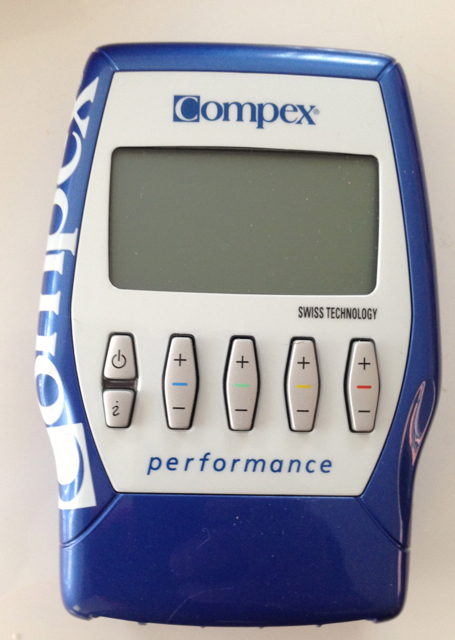
The other tool I use is the Compex Electrostim.  These have some a long way since the old days of simply placing the electrodes on your chest and hitting a button.  Modern units have variable levels - even specific programs.  For example the unit I use has an endurance program which uses shorter duration 'shocks'.  I use this to build strength but also to fatigue my legs before a flat ride to solicit greater fiber recruitment.

BTW - It's also good justification to keep shaving my legs.  Pulling the electrodes off hairy legs is not a highlight of the day..


Tip 9.  Consider using alternate tools such as electrostim, aqua jogging to create muscle contractions without loading the injured area.

As you can see dealing with an injury is holistic.  You should look at diet, look at alternate 'tools', work with a professional etc.  Trying to do this on your own (from my martial arts days my injury list is long so have spent years looking at this :)) is difficult and time consuming especially with the amount of mis-information out there so this leads me to the final and most important point.

Tip 10.  TELL YOUR COACH.  They wont (or shouldn't) think you are soft but will work with you.


Wednesday, 8 May 2013

The Little Engine that could - A Scientific View


"I think I can, I think I can...".  We've all heard the story of the Little Engine believing it could puff

right over that hill. We've all heard Henry Fords famous quote "Whether you think you can or you think you cant - you're right".  But what if there was actually a scientific reason for why this works ?


Your brain's number one priority is self preservation.  If it doesnt function your body dies.  So above all else it prioritises it's own protection.  Your brain knows what it needs (and doesnt need).

1.  Oxygen
2.  Fuel
3.  Avoid Trauma

As you can see running a sub 3 hour marathon doesnt appear in this list.

The brain subconsciously uses a number of pathways to enforce these priorities.  Two that are of interest from an endurance and athletic performance are the Vagus and Golgi nerve Pathways.

Vagus Nerve
The Vagus nerve is part of our parasympathetic nervous system which controls all organs except for the adrenal glands (which are part of the sympathetic nervous system - fight or flight).  Specifically for us the vagus nerve lowers cardiac output.  Ever wondered what actually controls Maximum Heart Rate (MHR) - that's the Vagus Nerve.  When the brain senses (or more importantly 'believes') it is at risk it will decrease cardiac rate essentially slowing us down so that more oxygen and blood glucose is available to the brain rather than the muscles.  Essentially our brain slows us down whether we like it or not.

Interesting your brain will also produce seratonin when your body works hard.  The 'Runners High" isnt a reward - it is our brains way of trying to relax us so as not to work so hard.

Golgi Nerve
The golgi nerve controls the maximum contractional force of a muscle.  Every heard the stories of people who never went to the gym geting trapped under a car and suddenly lift an engine block off their chest ?  They tear muscles doing it.  In essence the brain is overriding the Golgi nerve.

As a personal trainer I used to see this a lot.  A client would struggle to do 8 bench press reps and then quit.  I'd say lets do 4 more - I'll lift the weight off you - you just lower it.  That's is exactly what we would do - 4 more reps.  Except I wasnt lifting it off them (sometimes I wouldnt even be touching the bar).  The brain was placated, it didnt think it was at risk due to a bar being dropped on its blood supply, so your muscles could do the work.  Ever tried standing in front of a bench -you really want to jump onto it but something stops you ?  You squat down a bit but physically cant jump ?  That's the brain stopping your muscles from contracting

It is pretty clear how this applies to endurance sports - in simple terms if our brain doesnt believe we can do something and thinks it is at risk it will slow us down and make us less powerful. Let me repeat that - in simple terms if our brain doesnt believe we can do something and thinks it is at risk it will slow us down and make us less powerful.

So how do you do this ?  Is it as simple as just being like the Little Engine and saying "I think I can".  No (although that doesn't hurt).  Saying something doesn't mean you believe it and frankly your brain has no reason to trust you :).  You need to convince your brain that it is 'safe'.

1.  Pushing the limit past failure in a safe environment.
Interval and Repetition pace reps, HARD anaerobic efforts all serve to convince the brain that it can safely allow the heart to operate at a higher level (Vagus Nerve) 

2.  Forced Reps.
Like the fake spotter forcing reps will also help placate the brain.  Negative reps, over-speed work on the bike, treadmill, pool all help convince the brain our muscles can work harder (Golgi Nerve).

3.  Belief.
Self belief is a hard thing to implement - so try trusting someone else.  One common fact I see in high performers in business and sports is not a belief that they 'can' but more a lack of belief that they cant.  They trust in the science - the PhD scholars for wattage, running pace etc and, as Nike says, "Just Do It".  Their belief is in the science and 'logic'.  What is interesting is that I see that high performers are the least likely to ask 'Why ?" for a particular set.  'Why' often indicates, either consciously or sub consciously, that doubt exists which is then used by the brain to validate protecting you.

I like the quote by the Spinervals guy (who also did a sub 9 ironman at Kona) - Troy Jacobsen when he says "You pass out before you die"

It is often said that endurance sports are 70% mentally.  As you can see this is medically true - training the parasympathetic nerve path ways can improve our performance more than hours and hours of comfort zone training


Saturday, 30 March 2013

Dark Speed Bag Mount

One of the limitations of the current Specialized Shiv is the ability to mount bags on the top tube.  New bikes such as the Cervelo P5, Trek Speed Concept and BMC all now include bidon mounts on the top tube and a number of bag manufacturers are now making bags specifically for these mounts.

Whilst the Specialized Shiv doesn't contain such mounts and drilling into the frame would be dangerous the Fuelselage cover does create an opportunity to mount a bag.


The hard plastic fuelselage cover is held in place by a standard size M3 screw.  The first step was to drill another hole within the plastic cover.


Two holes were then drilled in the plastic former within the bag so that screws could be passed through that align with the standard and new cover holes.  A nylex nut was then used on the new bolt to secure the bag.


The cover was then replaced ensuring the tab fitted into the frame.  The screw without the nut simply screwed down into the existing thread within the frame.  Most of the velcro straps on the bag were now unnecessary and were cut off however for stability purposes the strap furtherest from the head stem was shortened and utilised.


Note this means the internal bladder cannot be used however I use seat mounted bottles so this is not a major concern versus carrying sufficient gels etc.